Often after I write a blog post, I'm very pleased with myself for about ten minutes, and then I start to wonder if I said something stupid in the post. I go back, look it over, fix a few spelling issues, then re-post it. But slowly I start to realize some of the things I said might be a little over the top or even wrong.
So, this is me realizing that some of what I said in my last post could be taken the wrong way. First of all, although I personally have decided I don't want to put up pictures of celebrities on my wall anymore, that doesn't mean I think you should do the same. But I do want you to ask yourself whether you're objectifying those celebrities.
Second, it's not wrong to recognize attractive qualities in the opposite gender. If you think Brad Pitt is good-looking, that's not a bad thing. If people weren't attracted to each other the human race would be doomed.
What bothers me is when people start comparing wonderful, amazing people right in front of them (including themselves) to images. It's when you see a poster of a guy and all you can think is, "He's hot," when right next door there's a beautiful man who's got so much soul but you don't recognize it because you've started to objectify men and see them only as good-looking things (same goes for women).
I think I've got all my bases covered this time.
Sunday, September 1, 2013

Thursday, August 29, 2013
The Objectification of Men
Okay, before all the feminists jump down my throat, I certainly recognize that women are objectified in our society, that it's a real problem, and that it needs to stop. But I feel that men are similarly objectified, and few people are talking about it, at least that I know of.
A while ago, a friend of mine showed me her friend's Pinterest board entitled, "I Just Love to Look at Him." The pins were of attractive male celebrities, and most of them were shirtless. My friend and I didn't necessarily approve of the board, but a male friend of ours happened to be in the room and said something to the effect of, "Oh, so when a girl oggles a shirtless man it's okay, but if a boy looks twice at a girl in a bikini it's not? How would you feel if I had a Pinterest board devoted to attractive, scantily-clad women?" We tried to explain that we were only looking at the board because we thought it was funny that the board existed, not because we were oggling.
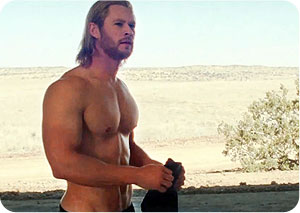
But it got me thinking about how often I get offended when men talk about "hot" girls in movies, yet that's
exactly how I described Chris Hemsworth when I saw him in Thor. In fact in high school I had a wall in my room devoted to pictures of Orlando Bloom and Tom Welling, though in none of them were they shirtless. I had never thought before that I was doing exactly what I wouldn't want my guy friends to do: comparing real people to a false ideal.
We talk about how young girls' perceptions of beauty are skewed because of how women are portrayed in media, but is a similar thing happening to young boys who see their sisters putting up the latest calendar of ab-sculpted firemen? This video is from a while ago, but I think it's still very pertinent. Women may not see themselves as beautiful because our standard of beauty is fake. I wonder if men feel similarly.
According to a parody on Dove's Real Beauty Sketches, the answer is no. In the original, women describe themselves to a sketch artist, then another person described them, and they saw the two results. Invariably, the second picture was more beautiful than the first because, as the ending states, women are more beautiful than they think. In the parody, the same thing happens with a group of men, except the results are opposite: the first picture is of a movie star, and the second is horrible. At the end, it says, "Men, you're less beautiful than you think." While hopefully we can chuckle good-humoredly at the joke, I think we should also recognize that it is a joke, not reality. Men don't necessarily see themselves as beautiful.
Many of the men I've interacted with, in fact, don't have high self-esteem. They see themselves as too fat, too thin, not muscular enough, too short, and even too tall. They don't like their hair color, or say they don't have enough hair. They criticize themselves as women do, offhandedly and usually without malice. Once, several of my girl friends and I wanted to organize a group and sing to the men who lived in our apartment complex, "That's What Makes You Beautiful," by One Direction. I regret that we never did it. Those men didn't realize that we saw them as amazing, attractive guys just as they saw us as amazing, attractive girls.
With all of this on my mind, when I started dating my last boyfriend, I glanced up at the framed picture of David Tennant on my wall and I took it down. I wouldn't want him to think that I found The Doctor more handsome than him. Nor would I feel comfortable if he had a picture of, say, Billie Piper on his wall, possibly comparing her to me.
I think it's time we recognize that objectification happens to both sexes and it's not okay, and that all of us, men and women, are beautiful the way we are.
A while ago, a friend of mine showed me her friend's Pinterest board entitled, "I Just Love to Look at Him." The pins were of attractive male celebrities, and most of them were shirtless. My friend and I didn't necessarily approve of the board, but a male friend of ours happened to be in the room and said something to the effect of, "Oh, so when a girl oggles a shirtless man it's okay, but if a boy looks twice at a girl in a bikini it's not? How would you feel if I had a Pinterest board devoted to attractive, scantily-clad women?" We tried to explain that we were only looking at the board because we thought it was funny that the board existed, not because we were oggling.
But it got me thinking about how often I get offended when men talk about "hot" girls in movies, yet that's
exactly how I described Chris Hemsworth when I saw him in Thor. In fact in high school I had a wall in my room devoted to pictures of Orlando Bloom and Tom Welling, though in none of them were they shirtless. I had never thought before that I was doing exactly what I wouldn't want my guy friends to do: comparing real people to a false ideal.
We talk about how young girls' perceptions of beauty are skewed because of how women are portrayed in media, but is a similar thing happening to young boys who see their sisters putting up the latest calendar of ab-sculpted firemen? This video is from a while ago, but I think it's still very pertinent. Women may not see themselves as beautiful because our standard of beauty is fake. I wonder if men feel similarly.
According to a parody on Dove's Real Beauty Sketches, the answer is no. In the original, women describe themselves to a sketch artist, then another person described them, and they saw the two results. Invariably, the second picture was more beautiful than the first because, as the ending states, women are more beautiful than they think. In the parody, the same thing happens with a group of men, except the results are opposite: the first picture is of a movie star, and the second is horrible. At the end, it says, "Men, you're less beautiful than you think." While hopefully we can chuckle good-humoredly at the joke, I think we should also recognize that it is a joke, not reality. Men don't necessarily see themselves as beautiful.
Many of the men I've interacted with, in fact, don't have high self-esteem. They see themselves as too fat, too thin, not muscular enough, too short, and even too tall. They don't like their hair color, or say they don't have enough hair. They criticize themselves as women do, offhandedly and usually without malice. Once, several of my girl friends and I wanted to organize a group and sing to the men who lived in our apartment complex, "That's What Makes You Beautiful," by One Direction. I regret that we never did it. Those men didn't realize that we saw them as amazing, attractive guys just as they saw us as amazing, attractive girls.
With all of this on my mind, when I started dating my last boyfriend, I glanced up at the framed picture of David Tennant on my wall and I took it down. I wouldn't want him to think that I found The Doctor more handsome than him. Nor would I feel comfortable if he had a picture of, say, Billie Piper on his wall, possibly comparing her to me.
I think it's time we recognize that objectification happens to both sexes and it's not okay, and that all of us, men and women, are beautiful the way we are.
Thursday, June 20, 2013
A Nook Versus a Book
A couple of months ago, I got a Nook. I've enjoyed it, but recently I've had some experiences which got me thinking: is my e-reader really that much better than a book?
First of all, there's the battery issue. My Nook requires that I charge it every other day on average if I want to be sure I can continue reading without my device shutting down in the middle of a chapter. This is especially an issue if I know I'm going to be reading in the car or somewhere far from an outlet or my charger. A book never needs to be charged, and I never need to worry about where I'll be when it loses power.
Also, I'd never considered before this month how important location is when reading my Nook. I went on a trip to Europe and took my Nook with me so I could read on the 8-hour flight. However, I remembered after taking my seat that until we got to a certain altitude, I wouldn't be allowed to use my device. I was literally sitting next to a girl who was reading a book during take off while I had nothing to do but stare out my window. This may not seem like a huge issue when you think about how long it actually takes to reach a safe altitude and how often I fly, but at that moment it was a big deal. Are there other places a person would be restricted from using an e-reader but allowed to read a book?
My next complaint is primarily about the Nook and not necessarily about other e-readers. The Nook has a nice feature called "LendMe" where you can share books you've bought with your friends. One problem is that your friends also have to own Nooks (not Kindles) and therefore if you're the only person who owns a Nook in your circle of friends, you cannot share or borrow books, which is something I've relied on heavily as a reader through the years.
This raises another question. Is there a system set up yet that will allow you to borrow books for a few weeks in a library format? Until that happens, I may have to continue using printed books simply because I can't buy every book I want to read, and therefore must go to the library.
Now, of course the Nook and other e-readers have some positive traits that books don't. They can hold tons of books, cutting down on weight and space. E-books are less expensive than printed works because publishing companies don't have to pay for ink and paper costs. I've noticed it's easier for me to sit in virtually any position and still comfortably read (one handed, I'll add, since I don't have to hold a page open). There are other benefits that come with having a tablet, which is what most e-readers essentially are.
So who wins the competition, Nook or book? I'm still not sure, but I think there are changes that need to be made before the world can completely switch from printed books to e-readers.
Thursday, April 4, 2013
Is School Interfering with My Learning?
I know what the purpose of homework is. At least I think I do. Correct me if I'm wrong, but I believe it's to give me a chance to practice what I've learned, and/or to increase my understanding of a concept outside of
class. Furthermore, I know the purpose of due dates. In my future career, I will most likely have dates when I will have to have projects or jobs finished. Also, having due dates teaches responsibility and planning. Now that that's established, I'm about to say some very mean things about homework, and I hope the reader will remember what I have already said.
Lately some interesting things have occurred in my education. The other week I had a large homework load, with several tests to take within a few days, and the due dates for some projects were and are still looming before me. I felt burnt out, but powered through the assignments, including one large paper. This paper in particular was difficult because I would have to find two articles to back up what I'd already found in a book. With everything going on that week, there simply wasn't time to find the articles, and I personally felt that what I had from the sources I'd already cited was good enough. I also realized that if I didn't turn in the paper on time, I would get a 0 for that assignment, which would take me down to a B- in the class. If, however, I could get only a 50%, I would keep an A-. So I decided to skip the articles, turn in the paper the way it was, and actually do my Astronomy homework also due that day. Something was better than nothing, right?
I was commiserating with my boyfriend and our mutual friend later that week about school, and our mutual friend mentioned that he had not yet turned in an assignment that had been due for nearly a week because he wanted it to be done just right; every day it was late he would lose a few percentage points, but he didn't mind as long as he could do a good job on it and be proud of the work he'd done. My boyfriend and I looked at each other and basically agreed (paraphrasing Sweet Brown), "Quality work? Ain't nobody got time for that!" I have, sadly, been struggling just to get my assignments finished. I know what I need to do to get a decent grade, and whether or not it's my best work I turn it in once it's done and move on to the next one. That's all I have time for.
But I envy that friend who cares more about being proud of his work than about his grade. After that conversation, I realized that for many of my classes, I have not learned a thing; I have done homework, and I have studied, but I have not learned.
Then something else happened. It has become fairly clear that I am not going to be accepted to medical school this year. While this is a blow, what's worse is knowing what to do next. If I were to reapply this year, my application would need to show that I have had multiple new experiences since the least time I applied in order to be taken seriously. I reviewed the last year and realized that I'd only volunteered at a retirement home for a total of 15 hours, and written my Honors Thesis. That isn't enough to be truly significant.
I felt like an idiot. Why hadn't I done more research or worked at a hospital or volunteered as a mentor? I had two semesters and, basically, all I'd done was... school. I'd been trying to keep my GPA high and take a few last undergraduate classes before moving on to more focused studies. I thought over each of my 4.5 years of college and wondered, "What have I been doing?" I realized that my extracurricular activities should have been more important than my schoolwork. I should have taken more time to serve the community, get involved in more clubs, and work. My best experiences have probably included tutoring at an elementary school, shadowing a physician, and serving the elderly. But I didn't do much of those things because I was busy with school.
That's not to say I haven't enjoyed many of my college courses. Anatomy, Physiology, Dissection Techniques, and Genetics were some of my favorites. I've enjoyed nearly all my English classes (which is good, because that was my major). I remember writing a paper about hair archetypes in art and how they have changed through the ages, and I loved it. In that same class a group of students and I made a pamphlet describing how to wax a snowboard; it was fun. That instructor told us to do whatever we wanted for our project, and so we got to be creative. It seems that whenever I'm free to learn at my own pace in my own way about whatever I want, I like it more, I learn more, and I retain more.
I don't completely blame school or my instructors for what's happened; obviously I have to put forth effort and desire in order to enjoy learning. But I have noticed that in classes where I have a list of things I have to do (I'm talking about stuff like, "You must write a five page paper on why birds fly south, and you must have four sources and at least one must be a book and at least one must be an article, and you have to use the vocabulary discussed in class"), I will absolutely do them, but it will be rote and with the minimum effort I can give. And I will pull off an A. In classes where I can learn about a subject I'm interested in without too many constraints, I'll run free and make a masterpiece, and I'll remember it forever. I have gotten lots of B's in my favorite classes, but I don't regret those B's. They were hard-won.
I can't blame a professor for giving homework, though I do resent it when he or she gives me a list of tasks rather than a plate of topics to learn about. But I will say this: I wish I had done what I love more, instead of doing what I had to in order to get a grade.
 |
| I really do love school... Usually |
Lately some interesting things have occurred in my education. The other week I had a large homework load, with several tests to take within a few days, and the due dates for some projects were and are still looming before me. I felt burnt out, but powered through the assignments, including one large paper. This paper in particular was difficult because I would have to find two articles to back up what I'd already found in a book. With everything going on that week, there simply wasn't time to find the articles, and I personally felt that what I had from the sources I'd already cited was good enough. I also realized that if I didn't turn in the paper on time, I would get a 0 for that assignment, which would take me down to a B- in the class. If, however, I could get only a 50%, I would keep an A-. So I decided to skip the articles, turn in the paper the way it was, and actually do my Astronomy homework also due that day. Something was better than nothing, right?
I was commiserating with my boyfriend and our mutual friend later that week about school, and our mutual friend mentioned that he had not yet turned in an assignment that had been due for nearly a week because he wanted it to be done just right; every day it was late he would lose a few percentage points, but he didn't mind as long as he could do a good job on it and be proud of the work he'd done. My boyfriend and I looked at each other and basically agreed (paraphrasing Sweet Brown), "Quality work? Ain't nobody got time for that!" I have, sadly, been struggling just to get my assignments finished. I know what I need to do to get a decent grade, and whether or not it's my best work I turn it in once it's done and move on to the next one. That's all I have time for.
But I envy that friend who cares more about being proud of his work than about his grade. After that conversation, I realized that for many of my classes, I have not learned a thing; I have done homework, and I have studied, but I have not learned.
Then something else happened. It has become fairly clear that I am not going to be accepted to medical school this year. While this is a blow, what's worse is knowing what to do next. If I were to reapply this year, my application would need to show that I have had multiple new experiences since the least time I applied in order to be taken seriously. I reviewed the last year and realized that I'd only volunteered at a retirement home for a total of 15 hours, and written my Honors Thesis. That isn't enough to be truly significant.
I felt like an idiot. Why hadn't I done more research or worked at a hospital or volunteered as a mentor? I had two semesters and, basically, all I'd done was... school. I'd been trying to keep my GPA high and take a few last undergraduate classes before moving on to more focused studies. I thought over each of my 4.5 years of college and wondered, "What have I been doing?" I realized that my extracurricular activities should have been more important than my schoolwork. I should have taken more time to serve the community, get involved in more clubs, and work. My best experiences have probably included tutoring at an elementary school, shadowing a physician, and serving the elderly. But I didn't do much of those things because I was busy with school.
That's not to say I haven't enjoyed many of my college courses. Anatomy, Physiology, Dissection Techniques, and Genetics were some of my favorites. I've enjoyed nearly all my English classes (which is good, because that was my major). I remember writing a paper about hair archetypes in art and how they have changed through the ages, and I loved it. In that same class a group of students and I made a pamphlet describing how to wax a snowboard; it was fun. That instructor told us to do whatever we wanted for our project, and so we got to be creative. It seems that whenever I'm free to learn at my own pace in my own way about whatever I want, I like it more, I learn more, and I retain more.
I don't completely blame school or my instructors for what's happened; obviously I have to put forth effort and desire in order to enjoy learning. But I have noticed that in classes where I have a list of things I have to do (I'm talking about stuff like, "You must write a five page paper on why birds fly south, and you must have four sources and at least one must be a book and at least one must be an article, and you have to use the vocabulary discussed in class"), I will absolutely do them, but it will be rote and with the minimum effort I can give. And I will pull off an A. In classes where I can learn about a subject I'm interested in without too many constraints, I'll run free and make a masterpiece, and I'll remember it forever. I have gotten lots of B's in my favorite classes, but I don't regret those B's. They were hard-won.
I can't blame a professor for giving homework, though I do resent it when he or she gives me a list of tasks rather than a plate of topics to learn about. But I will say this: I wish I had done what I love more, instead of doing what I had to in order to get a grade.
Tuesday, December 11, 2012
Reflecting on the Semester
It's been a good semester, and I've learned a lot and done some awesome things. So today I'm going to talk about those things.
Self-directed Learning/Personal Blog Posts
This class emphasized self-directed learning quite a bit. We were supposed to take charge of our education and seek out information on our own. I talked about my learning a little in some of my blog posts.
I studied several trends in digital culture, including hactivism, amateur business (including blogging and vlogging), online television watching, time-wasting and impatience (which I related to Dickens' Hard Times), and another collaborative novel, Atlanta Nights. Yes, I was all over the place. At the surface level, I talked about anything that caught my attention for more than five seconds. However, in this post, I demonstrated that I actually did have a theme. I was becoming more digitally cultured as I learned about these things, and I showed how our culture is progressing.
For the most part, I used Google+ to give examples of what we learned about in class. I mentioned Teach With Portals and Type Racer, both of which use gamification to teach skills. When we were talking about remix culture, I posted an article about Romeo and Juliet in the modern age, and then discussed The Lizzie Bennet Diaries webseries.
I read Hard Times by Charles Dickens and discussed it in several different ways. First, the speed of the Industrial Revolution is similar to our ever changing digital culture. Next, the loss of the individual in the utilitarian theory of Mr. Gradgrind relates to the question of identity in online avatars (which we discussed in our collaborative novel). As mentioned above, I discussed time and impatience in the novel and today. Finally, I found the theme of measuring in Hard Times, and related that to badges, "liking" on Facebook, and number of hits. The novel helped me notice trends in my culture that I may not have seen otherwise, and I started to wonder if these trends were good or bad.
Also, I read Bolter and Grusin's non-fiction book, Remediation. After reading about immediacy and hypermediacy, I constantly noticed whether or not I forgot that I was working with an interface while using various media. If I was constantly brought back into contact with the interface, I thought, "Hey, this is hypermedia. Are my senses being satiated in order to create the illusion of reality? If not, why am I using this?" It was interesting to ask myself how the media imitated real life, and I was more aware of the imitation.
Collaboration
This was a big part of our group project. My personal contributions included the following: after we all came up with ideas for our novel, I came up with a basic outline for the plot. The group gave me feedback, and I came back with a revised version, and then we tweaked it enough that we all liked it. Then we all created a a bio for various characters. My job was to flesh out James' background and personality. I also wrote the basic outline for two chapters for other contributors to work from. After we had the site up, I helped write a section of the novel. Finally, I found authors to help us out. I got a few friends to do some sections, and I also wrote to the Quark writing club, talked to my creative writing class, and a few other organizations, though I haven't seen any evidence that these latter groups ended up contributing.
I collaborated in other ways as well. I reviewed the first iteration of the Monster Mashup group's project, which I hope was helpful. Also, I submitted a poem to the Menagerie group for their site. In general, I tried to give feedback when I could during class presentations and on Google+, and I found additional information when it seemed helpful (like when we talked about net neutrality and I posted a review of Tim Wu's book The Master Switch).
Others' Assistance
All of my group members were very helpful. They each inspired me. In particular, Jason Hamilton, our group leader, kept me excited and motivated to finish our project. Another group member, Heather Anderson, helped me with topics outside of our project, too. Her blog focused on the good and bad of digital culture, and it was always helpful to see different sides to various subjects, including RFID tags and online connections. I've already mentioned in previous posts how Gwendolyn Hammer has helped me understand remix culture and Machinima.
Digital Literacy
I have definitely developed my digital literacy through consumption this semester. I began using Pinterest, Google Reader, and Google Sites for the first time, and used blogs and Google Docs more efficiently. These sites may seem very basic to others, but we all have to start somewhere. These have been helpful in and outside of class. For instance, I have used Pinterest to bookmark and find recipes for my dinner group (yes, I'm no longer just using it for Doctor Who!), and I waste less time thanks to Google Reader, since I no longer have to check through a million sites for updates; I just check Reader, and I don't have to look any further.
Most of my online creating has been through various blogs. My individual blog was useful to get my personal thoughts down, and on the group blog I posted a character bio and plot outline. Also, because of what I learned about amateur business and beta in this class, I started a creative writing blog, which may eventually bring me some revenue, and where I post rough drafts of poems and stories I've written.
Finally, I have connected with others online a lot this semester. Most of it was due to our collaborative project. I contacted friends, family, clubs, and people found through Google+ to help with the novel. Also, I connected with my group members on Google Docs and on Google+ in a much more efficient way than I have before. I love using Google Docs to do preliminary collaboration on a project now. I see that it's a good alpha- and beta-testing site to use when you're starting a group discussion. Then you can move it to more sophisticated sites and services.
That's one thing I've come to understand better this semester: once you consume, create, and connect, you have to start that process over again. After we received feedback about our group blog, we looked at other possible venues, and moved our project to a Google Site/Wiki. We made it as accessible as possible, then asked others to evaluate it, and submit material. After more feedback, we started the process again. Digital literacy has become a question of seeking social proof, and using that to improve the way I consume, create, and connect.
Self-directed Learning/Personal Blog Posts
This class emphasized self-directed learning quite a bit. We were supposed to take charge of our education and seek out information on our own. I talked about my learning a little in some of my blog posts.
I studied several trends in digital culture, including hactivism, amateur business (including blogging and vlogging), online television watching, time-wasting and impatience (which I related to Dickens' Hard Times), and another collaborative novel, Atlanta Nights. Yes, I was all over the place. At the surface level, I talked about anything that caught my attention for more than five seconds. However, in this post, I demonstrated that I actually did have a theme. I was becoming more digitally cultured as I learned about these things, and I showed how our culture is progressing.
For the most part, I used Google+ to give examples of what we learned about in class. I mentioned Teach With Portals and Type Racer, both of which use gamification to teach skills. When we were talking about remix culture, I posted an article about Romeo and Juliet in the modern age, and then discussed The Lizzie Bennet Diaries webseries.
I read Hard Times by Charles Dickens and discussed it in several different ways. First, the speed of the Industrial Revolution is similar to our ever changing digital culture. Next, the loss of the individual in the utilitarian theory of Mr. Gradgrind relates to the question of identity in online avatars (which we discussed in our collaborative novel). As mentioned above, I discussed time and impatience in the novel and today. Finally, I found the theme of measuring in Hard Times, and related that to badges, "liking" on Facebook, and number of hits. The novel helped me notice trends in my culture that I may not have seen otherwise, and I started to wonder if these trends were good or bad.
Also, I read Bolter and Grusin's non-fiction book, Remediation. After reading about immediacy and hypermediacy, I constantly noticed whether or not I forgot that I was working with an interface while using various media. If I was constantly brought back into contact with the interface, I thought, "Hey, this is hypermedia. Are my senses being satiated in order to create the illusion of reality? If not, why am I using this?" It was interesting to ask myself how the media imitated real life, and I was more aware of the imitation.
Collaboration
This was a big part of our group project. My personal contributions included the following: after we all came up with ideas for our novel, I came up with a basic outline for the plot. The group gave me feedback, and I came back with a revised version, and then we tweaked it enough that we all liked it. Then we all created a a bio for various characters. My job was to flesh out James' background and personality. I also wrote the basic outline for two chapters for other contributors to work from. After we had the site up, I helped write a section of the novel. Finally, I found authors to help us out. I got a few friends to do some sections, and I also wrote to the Quark writing club, talked to my creative writing class, and a few other organizations, though I haven't seen any evidence that these latter groups ended up contributing.
I collaborated in other ways as well. I reviewed the first iteration of the Monster Mashup group's project, which I hope was helpful. Also, I submitted a poem to the Menagerie group for their site. In general, I tried to give feedback when I could during class presentations and on Google+, and I found additional information when it seemed helpful (like when we talked about net neutrality and I posted a review of Tim Wu's book The Master Switch).
Others' Assistance
All of my group members were very helpful. They each inspired me. In particular, Jason Hamilton, our group leader, kept me excited and motivated to finish our project. Another group member, Heather Anderson, helped me with topics outside of our project, too. Her blog focused on the good and bad of digital culture, and it was always helpful to see different sides to various subjects, including RFID tags and online connections. I've already mentioned in previous posts how Gwendolyn Hammer has helped me understand remix culture and Machinima.
Digital Literacy
I have definitely developed my digital literacy through consumption this semester. I began using Pinterest, Google Reader, and Google Sites for the first time, and used blogs and Google Docs more efficiently. These sites may seem very basic to others, but we all have to start somewhere. These have been helpful in and outside of class. For instance, I have used Pinterest to bookmark and find recipes for my dinner group (yes, I'm no longer just using it for Doctor Who!), and I waste less time thanks to Google Reader, since I no longer have to check through a million sites for updates; I just check Reader, and I don't have to look any further.
Most of my online creating has been through various blogs. My individual blog was useful to get my personal thoughts down, and on the group blog I posted a character bio and plot outline. Also, because of what I learned about amateur business and beta in this class, I started a creative writing blog, which may eventually bring me some revenue, and where I post rough drafts of poems and stories I've written.
Finally, I have connected with others online a lot this semester. Most of it was due to our collaborative project. I contacted friends, family, clubs, and people found through Google+ to help with the novel. Also, I connected with my group members on Google Docs and on Google+ in a much more efficient way than I have before. I love using Google Docs to do preliminary collaboration on a project now. I see that it's a good alpha- and beta-testing site to use when you're starting a group discussion. Then you can move it to more sophisticated sites and services.
That's one thing I've come to understand better this semester: once you consume, create, and connect, you have to start that process over again. After we received feedback about our group blog, we looked at other possible venues, and moved our project to a Google Site/Wiki. We made it as accessible as possible, then asked others to evaluate it, and submit material. After more feedback, we started the process again. Digital literacy has become a question of seeking social proof, and using that to improve the way I consume, create, and connect.
Sunday, December 2, 2012
Final Exam Questions
Objective:
1. In Bolter and Grusin's Remediation: Understanding New Media, what is one difference between hypermediacy and immediacy?
a) Hypermediacy refers to media where you are so immersed in the media that you forget that you are using the interface, while immediacy refers to media where you are constantly brought back into contact with the interface.
b) Hypermediacy refers to media where you are constantly brought back into contact with the interface, while immediacy refers to media where you are so immersed in the media that you forget that you are using the interface.
c) Hypermediacy refers to media that represents old media in a new way, while immediacy refers to media that is completely different from old media and does not draw on the past.
d) Hypermediacy refers to media that is completely different from old media and does not draw on the past, while immediacy refers to media that represents old media in a new way.
Answer found here
2. _________ is a form of civil disobedience in digital culture. Examples include e-mail bombing, web page defacing, and web sit-ins.
Answer found here
3. Machinima uses video game engines to create movies. However, Gwendolyn Hammer points out that not all movies made with video games are Machinima. Why is that?
a) Machinima requires that you make your own story out of the game, not simply record the game being played.
b) Machinima requires that you use Bandicam to record it.
c) Machinima can only be done using PC games, not console games.
d) Machinima can only be done on games with a "Theater Mode."
Answer found here
Essay Questions:
1. Although our society is dependent on digital media, that does not mean we are addicted to it. Digital media allows us to do great things we couldn't do any other way, and we need it in order to get along, but that is not a bad thing.
See blog post here.
2. As Heather Anderson states, in the end, the majority will find the correct answer. Although Web 2.0 can sometimes lead to misinformation as many non-professionals comment online, when more people contribute and collaborate there is more accuracy as the many correct one another.
See blog post here.
1. In Bolter and Grusin's Remediation: Understanding New Media, what is one difference between hypermediacy and immediacy?
a) Hypermediacy refers to media where you are so immersed in the media that you forget that you are using the interface, while immediacy refers to media where you are constantly brought back into contact with the interface.
b) Hypermediacy refers to media where you are constantly brought back into contact with the interface, while immediacy refers to media where you are so immersed in the media that you forget that you are using the interface.
c) Hypermediacy refers to media that represents old media in a new way, while immediacy refers to media that is completely different from old media and does not draw on the past.
d) Hypermediacy refers to media that is completely different from old media and does not draw on the past, while immediacy refers to media that represents old media in a new way.
Answer found here
2. _________ is a form of civil disobedience in digital culture. Examples include e-mail bombing, web page defacing, and web sit-ins.
Answer found here
3. Machinima uses video game engines to create movies. However, Gwendolyn Hammer points out that not all movies made with video games are Machinima. Why is that?
a) Machinima requires that you make your own story out of the game, not simply record the game being played.
b) Machinima requires that you use Bandicam to record it.
c) Machinima can only be done using PC games, not console games.
d) Machinima can only be done on games with a "Theater Mode."
Answer found here
Essay Questions:
1. Although our society is dependent on digital media, that does not mean we are addicted to it. Digital media allows us to do great things we couldn't do any other way, and we need it in order to get along, but that is not a bad thing.
See blog post here.
2. As Heather Anderson states, in the end, the majority will find the correct answer. Although Web 2.0 can sometimes lead to misinformation as many non-professionals comment online, when more people contribute and collaborate there is more accuracy as the many correct one another.
See blog post here.
Sunday, November 25, 2012
The Blogging Mindset
It was Thanksgiving this week, and one of my favorite things about Thanksgiving is getting together with my extended family. This year is especially important because my paternal grandmother has been diagnosed with ALS, or Lou Gehrig's Disease. It's incurrable, and her condition will only worsen with time. So being with her and my grandfather, who is caring for her, was a big deal this year, since I don't know how much longer I'm going to have her in this life.
As usual, at the end of the feast we went around and everyone said what they're thankful for. The younger kids said, "Family," "Ditto," and "Mom." I said something that I wish was a little deeper, and then the parents got teary-eyed as they talked about their children and spouses. And then it got to Grandma and Grandpa. She said she's grateful for Grandpa. Grandpa, in turn, said that he's grateful to still have Grandma around, and that he's glad he's still healthy so he can care for her in their home and not at a clinic. And then he said that after she's gone there will be no reason for him to stick around any longer.
That might sound a little depressing, but my grandparents have a love story that inspires me. You see, my grandpa is a convert to the LDS church, and it was my grandmother that initially introduced him to it, and helped him throughout his conversion process. He told me that in his youth he'd searched for the true church, and when he couldn't find it, he turned to a more scientific approach to life. Then he met Grandma, and he found the truth as well. I'm probably getting that wrong, but that's what I understand. When I looked at them holding hands at the table, I thought that perhaps Grandpa loves Grandma so deeply because she is one of the reasons he now has an eternal family. So when he said after she goes he won't have a reason to stay, I wasn't really upset. He knows where they're going, and to be apart from his wife for very long would be worse than leaving this mortal life.
As I sat at the table, watching my grandparents hold hands, I thought of how strong their family is. Every one of their descendents over age 8 has been baptised, two grandkids have served missions with another currently serving, and two others have been married in the temple. We have strong testimonies of the gospel and of Jesus Christ, and we are a tightly-knit group. I think that we devote our well-being to our grandparents. Not only did they teach our parents, who then taught us, but they continually set an example for us. Their stalwart faith has given our family a rock to stand on. Their love has taught me what a normal relationship looks like.
I thought all this at dinner, and then I thought, "I want to blog about this." Why? Because I like talking. I like giving my opinions and telling stories. And I feel like my grandparents are inspiring. But blogging is kind of a new outlet for me. It suits me well. I feel like I've always had the blogging mindset. I like getting my thoughts down on paper, and I also like sharing those thoughts. Combine those together and you get a blog.
It's possible our generation has more of a blogging mindset because blogs are available. Or maybe humans always had that write/share mindset and now we just have a better means of enacting it. Anyway, it's something I've noticed lately. I like telling my story, and I like the idea that others can benefit from it, even if I don't know them. Blogging has been a great outlet for me for that reason.
My grandparents inspire me, and I'm grateful for both of them this Thanksgiving season. And I'm glad I could share some thoughts about them with you.
As usual, at the end of the feast we went around and everyone said what they're thankful for. The younger kids said, "Family," "Ditto," and "Mom." I said something that I wish was a little deeper, and then the parents got teary-eyed as they talked about their children and spouses. And then it got to Grandma and Grandpa. She said she's grateful for Grandpa. Grandpa, in turn, said that he's grateful to still have Grandma around, and that he's glad he's still healthy so he can care for her in their home and not at a clinic. And then he said that after she's gone there will be no reason for him to stick around any longer.
 |
| That's right, I'm related to them. |
That might sound a little depressing, but my grandparents have a love story that inspires me. You see, my grandpa is a convert to the LDS church, and it was my grandmother that initially introduced him to it, and helped him throughout his conversion process. He told me that in his youth he'd searched for the true church, and when he couldn't find it, he turned to a more scientific approach to life. Then he met Grandma, and he found the truth as well. I'm probably getting that wrong, but that's what I understand. When I looked at them holding hands at the table, I thought that perhaps Grandpa loves Grandma so deeply because she is one of the reasons he now has an eternal family. So when he said after she goes he won't have a reason to stay, I wasn't really upset. He knows where they're going, and to be apart from his wife for very long would be worse than leaving this mortal life.
As I sat at the table, watching my grandparents hold hands, I thought of how strong their family is. Every one of their descendents over age 8 has been baptised, two grandkids have served missions with another currently serving, and two others have been married in the temple. We have strong testimonies of the gospel and of Jesus Christ, and we are a tightly-knit group. I think that we devote our well-being to our grandparents. Not only did they teach our parents, who then taught us, but they continually set an example for us. Their stalwart faith has given our family a rock to stand on. Their love has taught me what a normal relationship looks like.
I thought all this at dinner, and then I thought, "I want to blog about this." Why? Because I like talking. I like giving my opinions and telling stories. And I feel like my grandparents are inspiring. But blogging is kind of a new outlet for me. It suits me well. I feel like I've always had the blogging mindset. I like getting my thoughts down on paper, and I also like sharing those thoughts. Combine those together and you get a blog.
It's possible our generation has more of a blogging mindset because blogs are available. Or maybe humans always had that write/share mindset and now we just have a better means of enacting it. Anyway, it's something I've noticed lately. I like telling my story, and I like the idea that others can benefit from it, even if I don't know them. Blogging has been a great outlet for me for that reason.
My grandparents inspire me, and I'm grateful for both of them this Thanksgiving season. And I'm glad I could share some thoughts about them with you.
Thursday, November 15, 2012
Ideas For Our Case Study
As we come to the end of the semester, we're trying to think of a case study group we could talk to about our collaborative novel. Here are some of my ideas:
We could present the idea to creative writing professors on campus. We could discuss how they could use this idea in their classes. Collaborative writing is a challenge, and online collaboration could be a good way for students to practice this form. Also, it might help students develop characters and plot. For example, one student must write an outline and a character bio that is complete enough that another student could write a short story/chapter about that character. Students realize how their characters need to be developed more. Finally, using this format, students recognize tone and style. They realize that they do have their own voice in writing and it is different from their classmates. It is a challenge to write like each other and try to keep the voice the same.
Another group to whom we could present our idea are creative writing clubs. In this case, the purpose is not so much teaching, but trying out a new form. It could be an activity for the group to try out. We can also explain that in this format, one author doesn't have to do so much. They can write a novel faster by crowd sourcing it.
Also, we could take this to a creative writing conference. We could talk about crowd sourcing and online creative writing projects going on right now, and then discuss our format. This might be a TedX style talk, where we show what we did and invite others to try it out. While this would be the best case study group as it would reach further, it might be hard to find a conference going on right now.
We could present the idea to creative writing professors on campus. We could discuss how they could use this idea in their classes. Collaborative writing is a challenge, and online collaboration could be a good way for students to practice this form. Also, it might help students develop characters and plot. For example, one student must write an outline and a character bio that is complete enough that another student could write a short story/chapter about that character. Students realize how their characters need to be developed more. Finally, using this format, students recognize tone and style. They realize that they do have their own voice in writing and it is different from their classmates. It is a challenge to write like each other and try to keep the voice the same.
Another group to whom we could present our idea are creative writing clubs. In this case, the purpose is not so much teaching, but trying out a new form. It could be an activity for the group to try out. We can also explain that in this format, one author doesn't have to do so much. They can write a novel faster by crowd sourcing it.
Also, we could take this to a creative writing conference. We could talk about crowd sourcing and online creative writing projects going on right now, and then discuss our format. This might be a TedX style talk, where we show what we did and invite others to try it out. While this would be the best case study group as it would reach further, it might be hard to find a conference going on right now.
Tuesday, November 13, 2012
If I could do it again
Project CCC is moving forward, but there are a few things I've noticed that might have helped make this go smoother. If anyone else attempts to write a collaborative novel, or if I could go back in time and give myself some advice when we first started, this is what I would say.
1. Allow adequate time. When we began this project, we assumed it wouldn't be too hard to find people to write for us, and since the segments would be so short, everyone could write their section in only a few hours. In reality, we had to keep pushing our deadlines back so we'd have time to find writers to fill up all the sections.
If I were to do this again, and if we didn't have the time constraints a semester imposes, I would have allowed more time to find authors, and for authors to find us. Ideally, I'd give it a month from the time we started accepting submissions to the time we closed it to the public. Then I'd give us another month to revise and publish. As it is, we're going to be pushing things to properly edit this novella.
2. Don't overestimate your number of collaborators, and recognize personal connections. As I mentioned, it was harder than we thought it would be to find people. Personally, I imagined opening this website to the public and getting tons of volunteers from across the country due to digital media. Our blog got around 400 hits that first month, so why wouldn't we have lots of authors from that alone? And then there was the Facebook group, and I assumed those members would tell their friends, who would tell their friends, and etc until we had to start saying, "Sorry, people, all the sections are filled." In the end, the people we got to sign up were mostly personal contacts. I texted a friend I know loves writing, and he got several people involved. We also went to clubs and classes on campus, and a few people from Engl 195 signed up. When we made personal or physical contact, that's when people started committing.
In a way, digital culture failed us here. While we may have gotten a couple of people to participate because they simply found our website or blog, our best contributors were actually people we already knew, or people we talked to face-to-face. Again, perhaps time was against us here. It's possible my dream of collaborators stumbling across our blog and volunteering their time would work if we left this open for several months. But if you need something done quick, think of your friends and family who already enjoy writing, go to them, and ask them to participate. Don't rely on unknown masses when time is of the essence.
3. Make a clear, clean website. This was something we heard again and again. We started off with a blog, which many found confusing. We then created a Google Site, hoping it would be more straightforward. While our content was finally in one place, and it explained more about how to contribute, we still had a problem with grabbing newcomers. It took too long to get into the plot line, the characters, and the novel in general.
We're working on these problems, but it's a little late in the game. Again, the timing thing got in our way. We needed an inviting, clear website that would introduce newcomers to the novel quickly (as in summarizing the plot and characters), but also explain in a clear way how to contribute to those who wanted to help write. This is perhaps one of the greatest things I've learned from this class: content must be accessible and understandable, and the format must be clean and easy to follow. There's no one way to do this, of course, and it requires lots of social proof to find out the best way to present your content. So if someone were to try our idea out for themselves, I would suggest they get feedback early about the website/blog/whatever digital media they use, and update it accordingly. Don't be afraid of beta, but try to get this part done early so your potential contributors don't get frustrated.
We've enjoyed Project CCC. Honestly, I loved collaborating with my team members about plot, characters, the website, and getting contributors, and I really liked writing my segment. If you haven't, you should check out our site at https://sites.google.com/site/collaborationfornovels/home and do a little collaborative writing. It's fun! You feel like you're part of something bigger than yourself. And I think this idea of online collaboration can work for a novel. It's still working for us. I just wish we'd done a few things differently.
1. Allow adequate time. When we began this project, we assumed it wouldn't be too hard to find people to write for us, and since the segments would be so short, everyone could write their section in only a few hours. In reality, we had to keep pushing our deadlines back so we'd have time to find writers to fill up all the sections.
If I were to do this again, and if we didn't have the time constraints a semester imposes, I would have allowed more time to find authors, and for authors to find us. Ideally, I'd give it a month from the time we started accepting submissions to the time we closed it to the public. Then I'd give us another month to revise and publish. As it is, we're going to be pushing things to properly edit this novella.
2. Don't overestimate your number of collaborators, and recognize personal connections. As I mentioned, it was harder than we thought it would be to find people. Personally, I imagined opening this website to the public and getting tons of volunteers from across the country due to digital media. Our blog got around 400 hits that first month, so why wouldn't we have lots of authors from that alone? And then there was the Facebook group, and I assumed those members would tell their friends, who would tell their friends, and etc until we had to start saying, "Sorry, people, all the sections are filled." In the end, the people we got to sign up were mostly personal contacts. I texted a friend I know loves writing, and he got several people involved. We also went to clubs and classes on campus, and a few people from Engl 195 signed up. When we made personal or physical contact, that's when people started committing.
In a way, digital culture failed us here. While we may have gotten a couple of people to participate because they simply found our website or blog, our best contributors were actually people we already knew, or people we talked to face-to-face. Again, perhaps time was against us here. It's possible my dream of collaborators stumbling across our blog and volunteering their time would work if we left this open for several months. But if you need something done quick, think of your friends and family who already enjoy writing, go to them, and ask them to participate. Don't rely on unknown masses when time is of the essence.
3. Make a clear, clean website. This was something we heard again and again. We started off with a blog, which many found confusing. We then created a Google Site, hoping it would be more straightforward. While our content was finally in one place, and it explained more about how to contribute, we still had a problem with grabbing newcomers. It took too long to get into the plot line, the characters, and the novel in general.
We're working on these problems, but it's a little late in the game. Again, the timing thing got in our way. We needed an inviting, clear website that would introduce newcomers to the novel quickly (as in summarizing the plot and characters), but also explain in a clear way how to contribute to those who wanted to help write. This is perhaps one of the greatest things I've learned from this class: content must be accessible and understandable, and the format must be clean and easy to follow. There's no one way to do this, of course, and it requires lots of social proof to find out the best way to present your content. So if someone were to try our idea out for themselves, I would suggest they get feedback early about the website/blog/whatever digital media they use, and update it accordingly. Don't be afraid of beta, but try to get this part done early so your potential contributors don't get frustrated.
We've enjoyed Project CCC. Honestly, I loved collaborating with my team members about plot, characters, the website, and getting contributors, and I really liked writing my segment. If you haven't, you should check out our site at https://sites.google.com/site/collaborationfornovels/home and do a little collaborative writing. It's fun! You feel like you're part of something bigger than yourself. And I think this idea of online collaboration can work for a novel. It's still working for us. I just wish we'd done a few things differently.
Saturday, November 10, 2012
Nostalgia
Thursday's class was very nostalgic. We talked about how video and computer games teach us skills. As we listed games such as Roller Coaster Tycoon, Sim City, and Civilization, which build civic and economic talents, I remembered playing these games as a kid. And I think I really did learn how to manage money and resources thanks to these games. They taught me that sometimes it's worth it to sacrifice a little now in order to get ahead later, but also that the big, shiny things aren't always the most useful.
This week, I traveled to Texas, and I remembered another important game from my childhood: Flight Simulator. I played it in a technology class in Junior High. No, really, it was assigned. I had to successfully take off, fly, and land a plane using some basic equipment like a joystick, brakes and gas pedals, and a computer. It was pretty awesome. I never really landed very well, but this week when I was sitting on my plane, waiting to take off, I remembered playing that game.
And I remembered you wait until you've reached a certain speed before lifting off the ground. I remembered you have to watch your instruments, but once you're in the air, you can basically relax. I remembered trying to land is like the hardest thing ever, and I usually ended up off the runway. Now, my future career has nothing to do with flying planes, but I have a greater appreciation for what my pilot is doing, and I understand what's happening and why when I fly.
Games like Flight Simulator actually are used in job training. Sometimes they aren't referred to as games, but they allow a person to practice a useful skill before they do it in real life. For instance, surgeons can practice various procedures using virtual reality simulators before they perform them on an actual patient.
When I was a kid, I never thought the games I was playing might be important to my personal development or career. Well, maybe those Jumpstart games. The school openly admitted they were trying to prepare you for the next year. But besides that, I was just having fun. Looking back, though, those games did change me. Even Flight Simulator, which didn't directly influence my future career, has given me more confidence while flying, and a greater appreciation for what's going on in the cockpit.
See, Parents? It wasn't all wasted time.
This week, I traveled to Texas, and I remembered another important game from my childhood: Flight Simulator. I played it in a technology class in Junior High. No, really, it was assigned. I had to successfully take off, fly, and land a plane using some basic equipment like a joystick, brakes and gas pedals, and a computer. It was pretty awesome. I never really landed very well, but this week when I was sitting on my plane, waiting to take off, I remembered playing that game.
 |
| Flight Simulator panel |
Games like Flight Simulator actually are used in job training. Sometimes they aren't referred to as games, but they allow a person to practice a useful skill before they do it in real life. For instance, surgeons can practice various procedures using virtual reality simulators before they perform them on an actual patient.
When I was a kid, I never thought the games I was playing might be important to my personal development or career. Well, maybe those Jumpstart games. The school openly admitted they were trying to prepare you for the next year. But besides that, I was just having fun. Looking back, though, those games did change me. Even Flight Simulator, which didn't directly influence my future career, has given me more confidence while flying, and a greater appreciation for what's going on in the cockpit.
See, Parents? It wasn't all wasted time.
Thursday, November 1, 2012
A Theme?
While I was planning out my Pinterest post (see previous), I came to a sudden and startling realization: my blog has a theme.
I didn't really have an introductory post. I just dove right into some self-directed learning. So I never really explained what this blog is about. I'm mostly doing this for my Digital Culture class. I came up with the name Culture in Progress because the course is about culture in the modern day being influenced by digital media and how culture then influences that media. I added the "in Progress" part because I figured it went along with the idea of things being in beta, and everything I write on this blog will be in beta, so it's all in progress. I thought it was witty.
As I went along, I was mostly just writing about whatever it was that came to mind. Hactivism, television ratings, relating Hard Times to time and measurement, and stuff relating to our collaborative project. What I didn't realize is that I have actually been talking about culture in progress the whole time. That is, how cultured I'm becoming, and how our culture is changing.
When I talked about television ratings, I was discussing how our ratings system needs to change due to our culture of watching TV online. When I talked about the value of beta, I showed how I have altered my way of thinking and embraced the learning that comes from projects in the beginning stages. When I compared Hard Times and industrialization to digitalization, I was trying to show how we need to draw on the past in order to cope with our rapidly changing world. We have to think differently but also remember inherent morals. All this time, I have been talking about culture in progress.
With my latest switch to Pinterest, I have become more digitally cultured. And I'm about to get an ebook reader, something I never thought I would do. If anyone was an advocate of "real" books, it was me. Now I'm seeing how helpful ebooks can be. I've learned to use other online resources as well. I haven't gotten a Twitter yet, but I've used Twitter Search a few times, and I've discovered many Google tools (docs, spreadsheets, sites) and used them this semester. Perhaps you'll laugh because I'm so obviously behind, but this is a big deal to me. I'm becoming more cultured digitally.
I'll see what I can do to keep up this theme. I know it hasn't always been obvious, nor has it been a central focus, but if you look it's there. I'm just amazed that it fit so perfectly with my title.
I didn't really have an introductory post. I just dove right into some self-directed learning. So I never really explained what this blog is about. I'm mostly doing this for my Digital Culture class. I came up with the name Culture in Progress because the course is about culture in the modern day being influenced by digital media and how culture then influences that media. I added the "in Progress" part because I figured it went along with the idea of things being in beta, and everything I write on this blog will be in beta, so it's all in progress. I thought it was witty.
 |
| Some people progress faster than others... |
When I talked about television ratings, I was discussing how our ratings system needs to change due to our culture of watching TV online. When I talked about the value of beta, I showed how I have altered my way of thinking and embraced the learning that comes from projects in the beginning stages. When I compared Hard Times and industrialization to digitalization, I was trying to show how we need to draw on the past in order to cope with our rapidly changing world. We have to think differently but also remember inherent morals. All this time, I have been talking about culture in progress.
With my latest switch to Pinterest, I have become more digitally cultured. And I'm about to get an ebook reader, something I never thought I would do. If anyone was an advocate of "real" books, it was me. Now I'm seeing how helpful ebooks can be. I've learned to use other online resources as well. I haven't gotten a Twitter yet, but I've used Twitter Search a few times, and I've discovered many Google tools (docs, spreadsheets, sites) and used them this semester. Perhaps you'll laugh because I'm so obviously behind, but this is a big deal to me. I'm becoming more cultured digitally.
I'll see what I can do to keep up this theme. I know it hasn't always been obvious, nor has it been a central focus, but if you look it's there. I'm just amazed that it fit so perfectly with my title.
How I got a Pinterest account
My roommate has been asking me to get a Pinterest for a while. I told her no because I get addicted to stuff really easily, especially online. I updated my Facebook status once or twice a day when I first got one. Now it's down to maybe once every three days... Anyway, I said I didn't need a Pinterest and it would just distract me.
The other day, however, I was online and I saw a Dr. Who picture that I thought was really funny. I saved it to my hard drive. My roommate, who was sitting next to me, said, "Did you just save that picture on your computer?"
"Yeah," I said. "I have a whole file in My Documents devoted to Dr. Who pictures. See?"
She stared at the screen a second, then said, "How is that different from getting a Pinterest and pinning photos to a board?"
I paused, then realized she was totally right. I still held off, though, until yesterday when I saw this YouTube video:
So, I got myself a Pinterest today. I have two boards, one with future wedding stuff, since my dear roommate wanted to me to make that one specifically, and one with Dr. Who. Perhaps it was a silly reason to finally cross over, but I did it.
My reason for joining Pinterest was probably not the reason most people do it. Most people seem to have cute, practical stuff like recipes or landscapes or dresses; I'm planning on a Portal board and maybe a Yu-Gi-Oh one, too. But it works for me. I have a place for my pictures and to find more pictures of stuff I like. Granted, the stuff I like is kind of nerdy. But once again, digital culture has proven to me it actually has exactly what I need.
The other day, however, I was online and I saw a Dr. Who picture that I thought was really funny. I saved it to my hard drive. My roommate, who was sitting next to me, said, "Did you just save that picture on your computer?"
"Yeah," I said. "I have a whole file in My Documents devoted to Dr. Who pictures. See?"
She stared at the screen a second, then said, "How is that different from getting a Pinterest and pinning photos to a board?"
I paused, then realized she was totally right. I still held off, though, until yesterday when I saw this YouTube video:
There's probably a way to save videos to your hard drive, but I haven't done much of it. I looked up at said roommate and asked, "Can you post videos to your Pinterest?" She told me yes.
My reason for joining Pinterest was probably not the reason most people do it. Most people seem to have cute, practical stuff like recipes or landscapes or dresses; I'm planning on a Portal board and maybe a Yu-Gi-Oh one, too. But it works for me. I have a place for my pictures and to find more pictures of stuff I like. Granted, the stuff I like is kind of nerdy. But once again, digital culture has proven to me it actually has exactly what I need.
Sunday, October 28, 2012
Why Atlanta Nights is Not Chaotic Connections
Our collaborative novel is open for writers. Sadly, no one has yet signed up outside of our group to help us write it. We're still hopeful, though; we have until the end of the week for the first draft to be due, and then the second and third drafts will be due on the 8th and 15th. So there's time.
After announcing on our Facebook page that it was time to start contributing, someone mentioned another collaborative science fiction/fantasy novel, Atlanta Nights by Travis Tea. I did a little research and found out Atlanta Nights was a hoax, written in response to several statements by PublishAmerica, an online publishing company. They claimed to accept high-quality manuscripts for publication. After submitting work to the site, PublishAmerica's Acquisitions staff reviewed the work to determine whether it was good enough for publication. Then they published an article that said this:
"[S]cience-fiction and fantasy writers have it easier. It's unfair, but such is life. As a rule of thumb, the quality bar for sci-fi and fantasy is a lot lower than for all other fiction. Therefore, beware of published authors who are self-crowned writing experts. When they tell you what to do and not to do in getting your book published, always first ask them what genre they write. If it's sci-fi or fantasy, run. They have no clue about what it is to write real-life stories, and how to find them a home. Unless you are a sci-fi or fantasy author yourself." (Author's Market: Never Trust the "Experts.")
In response, a group of science fiction and fantasy writers decided to write the worst novel ever and submit it to PublishAmerica. They were headed by James McDonald, and each author was given minimal information about the chapter outlines, plotline, character backgrounds, etc. and were expected to write a chapter without even knowing its place in the book. It led to random changes in setting, character races and genders, and plot (one character dies and then later shows up in the action). The authors made it even worse by misnumbering several chapters (there are two chapter 12's and no chapter 38).
They then submitted the work under the psuedonym Travis Tea (as in travesty) to PublishAmerica and were actually accepted by the Acquisitions staff who supposedly only took the most high-quality manuscripts. The team of writers decided not to publish in the end, and revealed the hoax. PublishAmerica then said that on further review, they would not take the manuscript.
Our collaborative novel, Chaotic Connections, is not Atlanta Nights. We have tried very hard to inform our writers of the plot, the chapter outlines, the characters, and the game setting. It's possible that we could have done more to help our authors understand these things, but even if there are discrepancies, we have plans to make the storyline smoother at the end with final revisions.
The greatest difference between the two novels, however, is that ours is meant to be somewhat readable, and the other was meant to be awful. We know that our novel may be a little strange in the end due to the many voices we have writing, but we hope that it will still be something you wouldn't mind reading. Atlanta Nights was constructed to be the worst book ever written.
I wonder which will be the greater success in the end. It seems to me that it would be easy for many authors to create something awful. It is much harder to create something good. I hope we achieve our goal at the same level that the authors of Atlanta Nights achieved theirs.
After announcing on our Facebook page that it was time to start contributing, someone mentioned another collaborative science fiction/fantasy novel, Atlanta Nights by Travis Tea. I did a little research and found out Atlanta Nights was a hoax, written in response to several statements by PublishAmerica, an online publishing company. They claimed to accept high-quality manuscripts for publication. After submitting work to the site, PublishAmerica's Acquisitions staff reviewed the work to determine whether it was good enough for publication. Then they published an article that said this:
"[S]cience-fiction and fantasy writers have it easier. It's unfair, but such is life. As a rule of thumb, the quality bar for sci-fi and fantasy is a lot lower than for all other fiction. Therefore, beware of published authors who are self-crowned writing experts. When they tell you what to do and not to do in getting your book published, always first ask them what genre they write. If it's sci-fi or fantasy, run. They have no clue about what it is to write real-life stories, and how to find them a home. Unless you are a sci-fi or fantasy author yourself." (Author's Market: Never Trust the "Experts.")
In response, a group of science fiction and fantasy writers decided to write the worst novel ever and submit it to PublishAmerica. They were headed by James McDonald, and each author was given minimal information about the chapter outlines, plotline, character backgrounds, etc. and were expected to write a chapter without even knowing its place in the book. It led to random changes in setting, character races and genders, and plot (one character dies and then later shows up in the action). The authors made it even worse by misnumbering several chapters (there are two chapter 12's and no chapter 38).
They then submitted the work under the psuedonym Travis Tea (as in travesty) to PublishAmerica and were actually accepted by the Acquisitions staff who supposedly only took the most high-quality manuscripts. The team of writers decided not to publish in the end, and revealed the hoax. PublishAmerica then said that on further review, they would not take the manuscript.
Our collaborative novel, Chaotic Connections, is not Atlanta Nights. We have tried very hard to inform our writers of the plot, the chapter outlines, the characters, and the game setting. It's possible that we could have done more to help our authors understand these things, but even if there are discrepancies, we have plans to make the storyline smoother at the end with final revisions.
The greatest difference between the two novels, however, is that ours is meant to be somewhat readable, and the other was meant to be awful. We know that our novel may be a little strange in the end due to the many voices we have writing, but we hope that it will still be something you wouldn't mind reading. Atlanta Nights was constructed to be the worst book ever written.
I wonder which will be the greater success in the end. It seems to me that it would be easy for many authors to create something awful. It is much harder to create something good. I hope we achieve our goal at the same level that the authors of Atlanta Nights achieved theirs.
Monday, October 22, 2012
The Value of Beta
Last night someone came and asked me how I got into creative writing. I was kind of confused by the question, since I've been doing it since before I could really spell. It's like asking someone how they got into eating. It's just something I do. But I told him that I started out tracing pictures from How to Draw books, and then I wrote stories to go along with them. Most of those stories were never finished. As I got older and the books I read changed, I started writing Middle Grade-ish novels. Those were never finished either.
Then I got into fan fiction. Yu-Gi-Oh fan fiction. Yes, Yu-Gi-Oh. I created a character, put her in the world of the TV show, and wrote several short stories about her. After having several strange dreams, I started coming up with an idea for a novel featuring this character, and after rewriting the plot several times, I cut out any references to Yu-Gi-Oh and have been working on a fantasy trilogy ever since. There are many other ideas I have for novels which I hope to write in the future, and I actually completed the rough draft of another novel this year.
The person to whom I was telling all this said he has thought of several characters, but he doesn't want to write a book about them yet because he doesn't want to write something terrible; he wants to save these characters until he's a good enough writer to create a story worthy of them.
 I can understand that; that used to be how I thought about blogging and submitting work for review by others. I didn't want anyone to see it until it was perfect, and I didn't even want to start it until I had a plan. How can I write a blog post when I'm still doing research?
But I don't see things that way any more. This post, itself, is a testament to that. I started off thinking, I wonder if I could relate that conversation I had last night to the value of beta. And then I just started on it. Beta, for me, is like practicing in front of a crowd. You're still working on it, but everyone gets to watch your progress. It's kind of nerve-wracking, but it's helpful to get feedback so you know what needs to be improved the most.
Going back to creative writing, I wrote tons of stories that never got done. I also wrote a lot of stuff that was downright ridiculous and let friends read to help me figure out what I needed to fix. Sometimes they rip it apart with criticism, but that's what I need. My fan fiction short stories will never be published formally. But all of these things had value. The novels I didn't finish and my silly fan fictions were important because they prepared me for later writing. And the criticism my friends gave me taught me to write better.
In my conversation last night, I told this person that he should just write about these characters. Put them in a situation and see what happens. You can always scrap that story and start again, and you can always change those characters and see how it changes your plot. Bad writing has worth. It teaches you. It helps you move forward. You might decide that you don't like where it's going at all and just throw out the whole thing, but you've learned and you've realized what doesn't work for you.
That's exactly what beta is. When you seek social proof in the middle of a project, you're learning. When you publish a blog post before you've done much research, you see what you need to find out. You see where your logic is lacking. You see your own thought process.
Don't be afraid of beta. It's a good thing.
Then I got into fan fiction. Yu-Gi-Oh fan fiction. Yes, Yu-Gi-Oh. I created a character, put her in the world of the TV show, and wrote several short stories about her. After having several strange dreams, I started coming up with an idea for a novel featuring this character, and after rewriting the plot several times, I cut out any references to Yu-Gi-Oh and have been working on a fantasy trilogy ever since. There are many other ideas I have for novels which I hope to write in the future, and I actually completed the rough draft of another novel this year.
The person to whom I was telling all this said he has thought of several characters, but he doesn't want to write a book about them yet because he doesn't want to write something terrible; he wants to save these characters until he's a good enough writer to create a story worthy of them.
But I don't see things that way any more. This post, itself, is a testament to that. I started off thinking, I wonder if I could relate that conversation I had last night to the value of beta. And then I just started on it. Beta, for me, is like practicing in front of a crowd. You're still working on it, but everyone gets to watch your progress. It's kind of nerve-wracking, but it's helpful to get feedback so you know what needs to be improved the most.
Going back to creative writing, I wrote tons of stories that never got done. I also wrote a lot of stuff that was downright ridiculous and let friends read to help me figure out what I needed to fix. Sometimes they rip it apart with criticism, but that's what I need. My fan fiction short stories will never be published formally. But all of these things had value. The novels I didn't finish and my silly fan fictions were important because they prepared me for later writing. And the criticism my friends gave me taught me to write better.
In my conversation last night, I told this person that he should just write about these characters. Put them in a situation and see what happens. You can always scrap that story and start again, and you can always change those characters and see how it changes your plot. Bad writing has worth. It teaches you. It helps you move forward. You might decide that you don't like where it's going at all and just throw out the whole thing, but you've learned and you've realized what doesn't work for you.
That's exactly what beta is. When you seek social proof in the middle of a project, you're learning. When you publish a blog post before you've done much research, you see what you need to find out. You see where your logic is lacking. You see your own thought process.
Don't be afraid of beta. It's a good thing.
Monday, October 15, 2012
Midterm Reflections
Let's take this step by step.
The first thing I think of when I ask myself, "What have I learned in this class so far?" is about collaboration. This shouldn't be surprising, considering my group project is devoted to writing a collaborative novel. But it's different from any other group project I've ever done. It's on a larger scale than any other I've worked on, for one. We're attempting to actually write and publish a novel before the end of the semester with the help of dozens of other people. And I think it's actually going to happen! After our meeting on Saturday, we laid out our timeline, the media we would use to get it done, and how we would get people involved, and I looked at it and thought, "Oh my gosh, this is actually possible. We're going to write a novel in less than a semester." Now, it may not be worthy of any awards, and it may be more of a novella in length, but it's happening.
Further, the level of media we're using to collaborate is different. We're on Google+ and Facebook, we have our own blog, and we're using Google Docs. I've used some of these media on other projects, but I feel like I know what I'm doing this time around. For once, I don't feel confused using Google Docs. The collaborative blog is new to me, but I'm getting the hang of it and I'm seeing the value of documenting our progress through the blog. It's like a journal of our project.
After collaboration, I think of the things I've learned from my peers. That, itself, is exciting. Much of my learning has come from other students. I first found out about Machinima from a blog by Gwendolyn Hammer. She also taught me about remix culture in another blog. In our class last Tuesday, I learned from my classmates about badges, how you can earn them, and why they are legitimate. Also, I had a great experience with the media fast, inspired by this blog by Curtis Jenkins (though I know many people were involved in making that happen). I've learned from my peers, and I've had self-directed learning experiences because of my peers. That's cool!
I want to mention briefly what I've learned about transmedia. After Dr. Burton explained this idea, I was very excited by it. Our collaborative group has done a bit of it, making twitter accounts for characters in our novel. I want to look into transmedia more in the future.
Next, I've been reading Hard Times, which I've posted about several times. I just like Dickens. Once again, I'm seeing the value in blogging about my thoughts before they're really complete thoughts. But more than that, I'm seeing connections between our busy digital age and the industrial era. I'm still finishing the book, but I'm already noticing that in order for Dickens' characters to be happy with their new industrial culture, they have to temper new ideas with the romance of the past. In the same way, we need to adapt to our digital culture by using the values and morals of our history. I've noted in other posts how the novel relates to badges and measuring quality, and to time management
The non-fiction text I read, Remediation, was a good introduction to media in general. Media should represent reality, either through hypermediacy or immediacy. I notice more often when media feels real to me, and how it's accomplishing that sensation.
Finally, I want to talk about my self-directed learning. Much of it has been through the videos and sites that I link to Google+ and my blog to confirm my understanding of concepts like remix culture, machinima, hactivism, etc. But lately I've been thinking a lot about blogging and vlogging, and learning how to do it better. I wrote a blog earlier about how you can make money off of your blog/vlog. And then this week, I noticed that an old blog I wrote in my digital civilization class is still getting hits. I haven't updated it since April, but it has gotten over a thousand views, many of which are from outside the US (54 are from Russia, 37 from Germany, and 32 from India). Most of the views are coming from people searching for "understanding modernism" and "for the people" on Google. I realized that my little blog actually does influence people. This excited me, terrified me, and made me want to make that and all my other blogs more appealing and useful. I can look at why people come to my blog to customize it to them and be more informative. A year ago I knew nothing about blogging, and now I'm learning how to use statistics and other tools to make my blogs better.
The first thing I think of when I ask myself, "What have I learned in this class so far?" is about collaboration. This shouldn't be surprising, considering my group project is devoted to writing a collaborative novel. But it's different from any other group project I've ever done. It's on a larger scale than any other I've worked on, for one. We're attempting to actually write and publish a novel before the end of the semester with the help of dozens of other people. And I think it's actually going to happen! After our meeting on Saturday, we laid out our timeline, the media we would use to get it done, and how we would get people involved, and I looked at it and thought, "Oh my gosh, this is actually possible. We're going to write a novel in less than a semester." Now, it may not be worthy of any awards, and it may be more of a novella in length, but it's happening.
Further, the level of media we're using to collaborate is different. We're on Google+ and Facebook, we have our own blog, and we're using Google Docs. I've used some of these media on other projects, but I feel like I know what I'm doing this time around. For once, I don't feel confused using Google Docs. The collaborative blog is new to me, but I'm getting the hang of it and I'm seeing the value of documenting our progress through the blog. It's like a journal of our project.
After collaboration, I think of the things I've learned from my peers. That, itself, is exciting. Much of my learning has come from other students. I first found out about Machinima from a blog by Gwendolyn Hammer. She also taught me about remix culture in another blog. In our class last Tuesday, I learned from my classmates about badges, how you can earn them, and why they are legitimate. Also, I had a great experience with the media fast, inspired by this blog by Curtis Jenkins (though I know many people were involved in making that happen). I've learned from my peers, and I've had self-directed learning experiences because of my peers. That's cool!
I want to mention briefly what I've learned about transmedia. After Dr. Burton explained this idea, I was very excited by it. Our collaborative group has done a bit of it, making twitter accounts for characters in our novel. I want to look into transmedia more in the future.
Next, I've been reading Hard Times, which I've posted about several times. I just like Dickens. Once again, I'm seeing the value in blogging about my thoughts before they're really complete thoughts. But more than that, I'm seeing connections between our busy digital age and the industrial era. I'm still finishing the book, but I'm already noticing that in order for Dickens' characters to be happy with their new industrial culture, they have to temper new ideas with the romance of the past. In the same way, we need to adapt to our digital culture by using the values and morals of our history. I've noted in other posts how the novel relates to badges and measuring quality, and to time management
The non-fiction text I read, Remediation, was a good introduction to media in general. Media should represent reality, either through hypermediacy or immediacy. I notice more often when media feels real to me, and how it's accomplishing that sensation.
Finally, I want to talk about my self-directed learning. Much of it has been through the videos and sites that I link to Google+ and my blog to confirm my understanding of concepts like remix culture, machinima, hactivism, etc. But lately I've been thinking a lot about blogging and vlogging, and learning how to do it better. I wrote a blog earlier about how you can make money off of your blog/vlog. And then this week, I noticed that an old blog I wrote in my digital civilization class is still getting hits. I haven't updated it since April, but it has gotten over a thousand views, many of which are from outside the US (54 are from Russia, 37 from Germany, and 32 from India). Most of the views are coming from people searching for "understanding modernism" and "for the people" on Google. I realized that my little blog actually does influence people. This excited me, terrified me, and made me want to make that and all my other blogs more appealing and useful. I can look at why people come to my blog to customize it to them and be more informative. A year ago I knew nothing about blogging, and now I'm learning how to use statistics and other tools to make my blogs better.
Sunday, October 14, 2012
Measuring in Hard Times
Another theme I've noticed in Hard Times is the idea of measuring. Mr. Gradgrind
is astounded when he realizes that Sissy Jupe's worth is not
calculable. "Somehow or other, he had become possessed by an idea that
there was something in this girl which could hardly be set forth in
tabular form.... he was not yet sure that if he had been required, for
example, to tick her off into columns in a parliamentary return, he
would have quite known how to divide her" (73). Sissy has not learned
much of facts in her time at the school, and she doesn't reason
according to mathematics, but according to the dictates of her own
consciousness. That is immeasureable.
In another section, focusing on the working class, Dickens notes, "It is known, to the force of a single pound weight, what the engine will do; but, not all the calculators of the National Debt can tell me the capacity for good or evil, for love or hatred, for patriotism or discontent, for the decomposition of virtue into vice, or the reverse, at any single moment in the soul of one of these its quiet servants" (56). During the Industrial Era, it was important to quantify the amount of something produced, the amount of cost, the amount of profit, the amount of time used, etc. Everything was calculated; yet the soul of man is incalculable by these means. The workers may be seen as cogs in the machine, but their value is not measurable. Sissy Jupe, though incapable of memorizing facts, does a great deal of good to Mrs. Gradgrind, and, as we see later, to everyone who comes in contact with her. People are worth more than the amount of products they produce; their true worth is not measurable by mortals.
Our society tries to quantify worth all the time. We've talked about badges in our class and how they are a new system of measuring someone's skills and qualifications. Also, in the digital age, anyone can contribute information and art online; material that isn't reviewed by an expert leads to questions like, "How do we know whether this is valid?"
We've discussed currency in our class relating to reputation. If something online is good, we need a way to quantify its value. We can do this by looking at ratings (so many stars or likes), the number of hits it receives, or the number of subscribers.
However, Dickens points out that it is difficult to measure some things. In this way, sometimes it is more helpful to read comments and opinions from friends on social networks in order to know how valuable something is, rather than trying to calculate or quantify its worth.
In another section, focusing on the working class, Dickens notes, "It is known, to the force of a single pound weight, what the engine will do; but, not all the calculators of the National Debt can tell me the capacity for good or evil, for love or hatred, for patriotism or discontent, for the decomposition of virtue into vice, or the reverse, at any single moment in the soul of one of these its quiet servants" (56). During the Industrial Era, it was important to quantify the amount of something produced, the amount of cost, the amount of profit, the amount of time used, etc. Everything was calculated; yet the soul of man is incalculable by these means. The workers may be seen as cogs in the machine, but their value is not measurable. Sissy Jupe, though incapable of memorizing facts, does a great deal of good to Mrs. Gradgrind, and, as we see later, to everyone who comes in contact with her. People are worth more than the amount of products they produce; their true worth is not measurable by mortals.
Our society tries to quantify worth all the time. We've talked about badges in our class and how they are a new system of measuring someone's skills and qualifications. Also, in the digital age, anyone can contribute information and art online; material that isn't reviewed by an expert leads to questions like, "How do we know whether this is valid?"
We've discussed currency in our class relating to reputation. If something online is good, we need a way to quantify its value. We can do this by looking at ratings (so many stars or likes), the number of hits it receives, or the number of subscribers.
However, Dickens points out that it is difficult to measure some things. In this way, sometimes it is more helpful to read comments and opinions from friends on social networks in order to know how valuable something is, rather than trying to calculate or quantify its worth.
Time in Hard Times
I wanted to talk about a theme I saw throughout the first book of Hard Times, the notion of time. Dickens refers to time as the Great Manufacturer; its products are people. Louisa and Thomas Gradgrind, Jr. enter and come out as a young woman and young man, both altered in some way or another thanks to the passage of time. Time as a factory is an interesting analogy, since time is also a very important commodity in Victorian life.
For instance, Mr. Bounderby and Mr. Gradgrind continually speak of not wasting time. They call the showmen and horse riders idle because they spend their time in amusement and not in business. Mr. Bounderby and Mr. Gradgrind live by idea that time is money.
Also, in Victorian England, time is continually hurrying on. There is a sense of rushing in every aspect of Coketown. The working class go to and from work, the machines whir, the trains run all day. A worker named Stephen Blackpool remarks to an older woman that Coketown is a busy place and she replies, "Eigh sure! Dreadful busy!" Only a short while later, Stephen notices the time, and quickens his pace. "He was going to work? the old woman said, quickening hers, too, quite easily. Yes, time was nearly out" (63). This is the general feeling of the Industrial Era. Everything has a schedule, and time must be used wisely to make the most out of it. People like Gradgrind and Bounderby see little use in leisure, since it profits them nothing, and is, essentially, a waste of time.
However, Mr. Sleary, who runs the horse show, says that people must be amused somehow; they can't always be working or always learning. He understands that time must be balanced, and life cannot be focused on only one thing. Then again, Sleary makes his money by amusing others, and so perhaps he would rather have people always spending their time in leisure instead of work. Still, as we will see in later books, those who do not have a balance end up falling.
Our digital age seems to be in a rush similar to Victorian England. Last year's technology is out of date. We're disgruntled if it takes a webpage longer than five seconds to load. Information is communicated so quickly, you can either be immediately informed, or you can fall behind in a matter of minutes. Check out this commercial from AT&T, where 27 seconds is enough time to distinguish those up on the times from everyone else:
Additionally, we now seem to have a similar problem with balancing our time, though instead of spending too much of it in work and learning, we spend too much on leisure. Some are addicted to surfing the internet or
playing video games. Procrastination is easy to do when there's so much to occupy our attention.
As Sleary said, we cannot always be working or learning, be we cannot always be playing, either. Balance is needed. I think that's the message for our digital age. Where we spend our time makes us into the people we'll be. Therefore, we need to balance our time on and offline, and between leisure and work.
For instance, Mr. Bounderby and Mr. Gradgrind continually speak of not wasting time. They call the showmen and horse riders idle because they spend their time in amusement and not in business. Mr. Bounderby and Mr. Gradgrind live by idea that time is money.
Also, in Victorian England, time is continually hurrying on. There is a sense of rushing in every aspect of Coketown. The working class go to and from work, the machines whir, the trains run all day. A worker named Stephen Blackpool remarks to an older woman that Coketown is a busy place and she replies, "Eigh sure! Dreadful busy!" Only a short while later, Stephen notices the time, and quickens his pace. "He was going to work? the old woman said, quickening hers, too, quite easily. Yes, time was nearly out" (63). This is the general feeling of the Industrial Era. Everything has a schedule, and time must be used wisely to make the most out of it. People like Gradgrind and Bounderby see little use in leisure, since it profits them nothing, and is, essentially, a waste of time.
However, Mr. Sleary, who runs the horse show, says that people must be amused somehow; they can't always be working or always learning. He understands that time must be balanced, and life cannot be focused on only one thing. Then again, Sleary makes his money by amusing others, and so perhaps he would rather have people always spending their time in leisure instead of work. Still, as we will see in later books, those who do not have a balance end up falling.
Our digital age seems to be in a rush similar to Victorian England. Last year's technology is out of date. We're disgruntled if it takes a webpage longer than five seconds to load. Information is communicated so quickly, you can either be immediately informed, or you can fall behind in a matter of minutes. Check out this commercial from AT&T, where 27 seconds is enough time to distinguish those up on the times from everyone else:
As Sleary said, we cannot always be working or learning, be we cannot always be playing, either. Balance is needed. I think that's the message for our digital age. Where we spend our time makes us into the people we'll be. Therefore, we need to balance our time on and offline, and between leisure and work.
Friday, October 12, 2012
New Plot
I wasn't sure whether or not my fellow group members saw this, and I want their opinion on it before I publish it to our Project CCC blog, so here it is in its beta phase.
Chapter 1: We begin with Polly in the middle of a job. She is in disguise once again, acting as a member of a drug ring. She just needs the drug lord to reveal more information (who else is involved, where they’re getting the drugs, and a clear, recorded statement that they can use in court). At last, the man says the last thing she needs, and then the special ops team comes in and incapacitates the members of the ring/arrests them. Introduce various characters and their specialties (Micro uses tech to sneak inside/prevent escape/set cool gadgets to catch bad guys, Jared tackles/throws stuff, Polly uses karate, Grant shoots and directs action, and Angelina… well, she does whatever she feels like). They cart the bad guys off to jail
Chapter 2: The team celebrates at a bar. We see some of their personalities and interactions. We also see Polly’s crush on Grant, and how she acts when around her teammates (as we see later, Polly acts differently depending on whom she’s with—comes from having to constantly change who she is as a spy). As they’re leaving for the night, Grant takes Polly aside and tells her he and Micro have tracked Dr. Herron to an address. They’ve been searching for Herron for years; they don’t know what he’s planning, but he’s a hacker who shows up every now and then online, getting into copyrighted work and stealing codes. Grant assigns Polly to go to the address and start finding out about him.
Chapter 3: Polly returns home and talks to her roommate, Jenna (Jenny?). We see that she acts differently around Jenna than around her coworkers. Then she hooks up to her online game. We see some of her life there. She meets up with James, another player in the 2nd life game who has been talking to Polly for a couple of months now. She talks to him about Grant, but of course can’t tell James about her real line of work. Perhaps we also see Angelina’s online identity (though we don’t know it’s her), who has also befriended Polly in the game.
Chapter 4: The next day or so, Polly contacts Dr. Herron. She claims to be his new neighbor (she’s renting the house next door as a ruse) and tries to become friends with him. He acts nice enough, but she’s unable to get inside the house. But she’s used to jobs taking a long time.
Chapter 5: Meanwhile, Polly is secretly commuting back to her real apartment so Jenna doesn’t get suspicious, and goes to work to collaborate with teammates about how to get Dr. Herron to reveal his secret. Micro explains more about what Dr. Herron has done in the past. They know he’s stealing codes, and that many of his activities seem to relate to the online game Polly is involved in. But they can’t tell exactly what Dr. Herron is up to. Everyone is assigned various jobs to find out what he’s doing according to their specialties. She still likes Grant, but we see that he’s not responding to her flirts.
Chapter 6: Polly continues to try to get Dr. Herron to trust her during the next week(s). Every day she talks to him just a little, then invites him for dinner at her place. He comes. There’s a dinner scene, and Polly can tell he’s beginning to see her as a friend. But when she offers to come to his house to look at a plumbing problem he mentions (she says she knows a little about that) he declines, saying he can figure it out. Still won’t let her in.
Chapter 7: Polly goes online to unwind and talk to James (she, of course, does this everyday, but this will be a scene rather than a summary). While talking to James today, Polly realizes she’s falling for him. She’s conflicted between her virtual life and reality with Grant - although Grant still doesn’t like her back, and James returns her flirts. She talks to Angelina’s avatar (again, doesn’t know it’s her, she’s just another online friend who knows James) about it, and she tells her to go for James.
Chapter 8: Polly goes over to Dr. Herron’s house to “borrow a cup of sugar.” He tells her to wait at the door. She’s frustrated with how he won’t let her in. When he returns they talk for a minute on the doorstep, then she goes to her house, with nothing to show for her work but an unneeded cup of sugar. She goes online again, and while talking to James, he says something that Dr. Herron said earlier. She realizes Dr. Herron and James are the same person.
Chapter 9: She’s conflicted between her fondness for James and her duty to work against Dr. Herron. She consults with Jenna without revealing too much, explaining that she’s fallen in love with a guy online, but she’s met him in real life, too, and he’s a jerk. How does she reconcile that? Jenna suggests she find out which part of him is his real personality—the online sweetheart, or the real life jerk. We’re different people online and offline, and one or the other can be a front. (sort of blatantly stating the theme). Tells Polly to get to know him better and then decide what do to.
Chapter 10: Polly decides she needs to find out exactly what Dr. Herron’s plot is before she can figure out what part of him is his real self. She finally gets inside by going over to his house and telling him her toilet is broken and she needs to use his bathroom. He is slow to let her in, but does. She notices several areas of the house he seems to be protecting. Asks him about it, but he makes excuses. Finally, Polly reveals that she is the girl he’s been talking to online. She says she knows he’s up to something—he’s obviously hiding something (doesn’t reveal she’s with the government)—and he can trust her. James/Dr. Herron explains that years ago, he was a hacker, and he was trying to use the codes he stole to control the people who were connected to the second life game (it would have made them into vegetables, their conscious minds trapped in the game. Anyone that logged on would have been stuck, and he could have used it to get ransoms from some very important people). However, Dr. Herron’s life was turned upside down when his best friend, the only person left in his life who cared about him, was killed by a random, petty thief. (see Herron’s bio for more). After years of mourning and soul-searching, he realized that little men, men like that petty thief, can do great harm. If he was a great man, he should be able to great things. So for the past couple of years, he’s been trying to not only right his wrongs, but secretly upgrade the security on the second life game so that no one could ever do what he tried years ago. The rooms he was trying to hide are full of electronic equipment and codes meant to reverse the damage he’s done. She’s relieved, but it’s very momentary because...
Chapter 11: Angelina and Micro run inside the house. They explain they were listening in. Micro tells Polly that Grant planted a recording device on Polly (he was getting suspicious and impatient with the job) and Micro found out and hacked the bug so he could listen as well. Micro was sitting with Angelina at work this morning when they overheard Polly’s conversation. Angelina quickly understood what was really going on (Polly is the girl she’s been talking to online, James, who is her friend, too, is Dr. Herron) and they came running to warn them: Grant is on his way. As soon as he heard Dr. Herron admit to hacking into those data bases years ago, he called the special ops team members and told them to head to Dr. Herron’s address. They want to help Dr. Herron because 1) Angelina knows he’s a good guy and 2) he has to close up those security holes he created.
However, before they can act, Grant and Jared arrive. Grant orders Jared (who doesn’t know anything about Dr. Herron’s confession) to grab Dr. Herron. Polly puts herself between Herron and Jared, as a shield and Angelina tries to stop Jared by talking to him (they’re good friends and he listens to her). Grant gets mad that Jared won’t do as he was ordered, and can’t understand why Angelina is defending Dr. Herron. Micro confesses that they heard the conversation between Polly and they know the real story: Herron is reformed, and they need to let him finish his work
Grant, however, is not willing to give up on a case he’s been working on for years. He shouts that Herron is a criminal for hacking codes and needs to be punished. He orders Jared again to grab Herron and for the others to start packing up the equipment for evidence. Herron tells them he was in the middle of something before Polly arrived, however, and if they try to unplug anything there could be a lot of problems. Grant thinks that’s ridiculous, that he’s just trying to stall, and Grant decides to get the job done himself. He tries to turn off one of the switchboards, is electrocuted and falls to the floor.
Chapter 12: Herron runs to the equipment. That shouldn’t have killed Grant. While the others try to revive Grant, Herron checks the monitors, and realized Grant actually activated the code he created years ago to trap everyone inside the game. Anyone who is logged on, or who does log on, will turn into a vegetable. There is a way to reverse it, but someone would have to go inside the game and alter the internal security settings while he worked in the physical world. Polly volunteers to go in, and so does Angelina. Micro, Jared, and Herron will stay outside and try to help Herron reverse it. Polly and Angelina meet up with Jenna in the virtual world, and all of them save the day by reversing the codes (I’m still working out the details there) and everyone gets out alive.
Chapter 13: Grant does not regain consciousness. They confront James/Dr. Herron about what he’s done. He might make a valuable asset to the team. Meanwhile, Polly confesses her feelings for James, and he does the same. Micro ends up with Jenna, who has become a good friend since his girlfriend broke up with him. (Who votes Jared ends up with Angelina, since he’s the first man who is thoughtful enough to see her for the person she is?)
Chapter 1: We begin with Polly in the middle of a job. She is in disguise once again, acting as a member of a drug ring. She just needs the drug lord to reveal more information (who else is involved, where they’re getting the drugs, and a clear, recorded statement that they can use in court). At last, the man says the last thing she needs, and then the special ops team comes in and incapacitates the members of the ring/arrests them. Introduce various characters and their specialties (Micro uses tech to sneak inside/prevent escape/set cool gadgets to catch bad guys, Jared tackles/throws stuff, Polly uses karate, Grant shoots and directs action, and Angelina… well, she does whatever she feels like). They cart the bad guys off to jail
Chapter 2: The team celebrates at a bar. We see some of their personalities and interactions. We also see Polly’s crush on Grant, and how she acts when around her teammates (as we see later, Polly acts differently depending on whom she’s with—comes from having to constantly change who she is as a spy). As they’re leaving for the night, Grant takes Polly aside and tells her he and Micro have tracked Dr. Herron to an address. They’ve been searching for Herron for years; they don’t know what he’s planning, but he’s a hacker who shows up every now and then online, getting into copyrighted work and stealing codes. Grant assigns Polly to go to the address and start finding out about him.
Chapter 3: Polly returns home and talks to her roommate, Jenna (Jenny?). We see that she acts differently around Jenna than around her coworkers. Then she hooks up to her online game. We see some of her life there. She meets up with James, another player in the 2nd life game who has been talking to Polly for a couple of months now. She talks to him about Grant, but of course can’t tell James about her real line of work. Perhaps we also see Angelina’s online identity (though we don’t know it’s her), who has also befriended Polly in the game.
Chapter 4: The next day or so, Polly contacts Dr. Herron. She claims to be his new neighbor (she’s renting the house next door as a ruse) and tries to become friends with him. He acts nice enough, but she’s unable to get inside the house. But she’s used to jobs taking a long time.
Chapter 5: Meanwhile, Polly is secretly commuting back to her real apartment so Jenna doesn’t get suspicious, and goes to work to collaborate with teammates about how to get Dr. Herron to reveal his secret. Micro explains more about what Dr. Herron has done in the past. They know he’s stealing codes, and that many of his activities seem to relate to the online game Polly is involved in. But they can’t tell exactly what Dr. Herron is up to. Everyone is assigned various jobs to find out what he’s doing according to their specialties. She still likes Grant, but we see that he’s not responding to her flirts.
Chapter 6: Polly continues to try to get Dr. Herron to trust her during the next week(s). Every day she talks to him just a little, then invites him for dinner at her place. He comes. There’s a dinner scene, and Polly can tell he’s beginning to see her as a friend. But when she offers to come to his house to look at a plumbing problem he mentions (she says she knows a little about that) he declines, saying he can figure it out. Still won’t let her in.
Chapter 7: Polly goes online to unwind and talk to James (she, of course, does this everyday, but this will be a scene rather than a summary). While talking to James today, Polly realizes she’s falling for him. She’s conflicted between her virtual life and reality with Grant - although Grant still doesn’t like her back, and James returns her flirts. She talks to Angelina’s avatar (again, doesn’t know it’s her, she’s just another online friend who knows James) about it, and she tells her to go for James.
Chapter 8: Polly goes over to Dr. Herron’s house to “borrow a cup of sugar.” He tells her to wait at the door. She’s frustrated with how he won’t let her in. When he returns they talk for a minute on the doorstep, then she goes to her house, with nothing to show for her work but an unneeded cup of sugar. She goes online again, and while talking to James, he says something that Dr. Herron said earlier. She realizes Dr. Herron and James are the same person.
Chapter 9: She’s conflicted between her fondness for James and her duty to work against Dr. Herron. She consults with Jenna without revealing too much, explaining that she’s fallen in love with a guy online, but she’s met him in real life, too, and he’s a jerk. How does she reconcile that? Jenna suggests she find out which part of him is his real personality—the online sweetheart, or the real life jerk. We’re different people online and offline, and one or the other can be a front. (sort of blatantly stating the theme). Tells Polly to get to know him better and then decide what do to.
Chapter 10: Polly decides she needs to find out exactly what Dr. Herron’s plot is before she can figure out what part of him is his real self. She finally gets inside by going over to his house and telling him her toilet is broken and she needs to use his bathroom. He is slow to let her in, but does. She notices several areas of the house he seems to be protecting. Asks him about it, but he makes excuses. Finally, Polly reveals that she is the girl he’s been talking to online. She says she knows he’s up to something—he’s obviously hiding something (doesn’t reveal she’s with the government)—and he can trust her. James/Dr. Herron explains that years ago, he was a hacker, and he was trying to use the codes he stole to control the people who were connected to the second life game (it would have made them into vegetables, their conscious minds trapped in the game. Anyone that logged on would have been stuck, and he could have used it to get ransoms from some very important people). However, Dr. Herron’s life was turned upside down when his best friend, the only person left in his life who cared about him, was killed by a random, petty thief. (see Herron’s bio for more). After years of mourning and soul-searching, he realized that little men, men like that petty thief, can do great harm. If he was a great man, he should be able to great things. So for the past couple of years, he’s been trying to not only right his wrongs, but secretly upgrade the security on the second life game so that no one could ever do what he tried years ago. The rooms he was trying to hide are full of electronic equipment and codes meant to reverse the damage he’s done. She’s relieved, but it’s very momentary because...
Chapter 11: Angelina and Micro run inside the house. They explain they were listening in. Micro tells Polly that Grant planted a recording device on Polly (he was getting suspicious and impatient with the job) and Micro found out and hacked the bug so he could listen as well. Micro was sitting with Angelina at work this morning when they overheard Polly’s conversation. Angelina quickly understood what was really going on (Polly is the girl she’s been talking to online, James, who is her friend, too, is Dr. Herron) and they came running to warn them: Grant is on his way. As soon as he heard Dr. Herron admit to hacking into those data bases years ago, he called the special ops team members and told them to head to Dr. Herron’s address. They want to help Dr. Herron because 1) Angelina knows he’s a good guy and 2) he has to close up those security holes he created.
However, before they can act, Grant and Jared arrive. Grant orders Jared (who doesn’t know anything about Dr. Herron’s confession) to grab Dr. Herron. Polly puts herself between Herron and Jared, as a shield and Angelina tries to stop Jared by talking to him (they’re good friends and he listens to her). Grant gets mad that Jared won’t do as he was ordered, and can’t understand why Angelina is defending Dr. Herron. Micro confesses that they heard the conversation between Polly and they know the real story: Herron is reformed, and they need to let him finish his work
Grant, however, is not willing to give up on a case he’s been working on for years. He shouts that Herron is a criminal for hacking codes and needs to be punished. He orders Jared again to grab Herron and for the others to start packing up the equipment for evidence. Herron tells them he was in the middle of something before Polly arrived, however, and if they try to unplug anything there could be a lot of problems. Grant thinks that’s ridiculous, that he’s just trying to stall, and Grant decides to get the job done himself. He tries to turn off one of the switchboards, is electrocuted and falls to the floor.
Chapter 12: Herron runs to the equipment. That shouldn’t have killed Grant. While the others try to revive Grant, Herron checks the monitors, and realized Grant actually activated the code he created years ago to trap everyone inside the game. Anyone who is logged on, or who does log on, will turn into a vegetable. There is a way to reverse it, but someone would have to go inside the game and alter the internal security settings while he worked in the physical world. Polly volunteers to go in, and so does Angelina. Micro, Jared, and Herron will stay outside and try to help Herron reverse it. Polly and Angelina meet up with Jenna in the virtual world, and all of them save the day by reversing the codes (I’m still working out the details there) and everyone gets out alive.
Chapter 13: Grant does not regain consciousness. They confront James/Dr. Herron about what he’s done. He might make a valuable asset to the team. Meanwhile, Polly confesses her feelings for James, and he does the same. Micro ends up with Jenna, who has become a good friend since his girlfriend broke up with him. (Who votes Jared ends up with Angelina, since he’s the first man who is thoughtful enough to see her for the person she is?)
Wednesday, October 3, 2012
Critique of Proposal: Remix Project
This week in my Digital Culture Class, we wrote proposals for our group projects. Here's the proposal for the project I'm participating in:
http://ourdangerouselife.blogspot.com/2012/10/project-title-crowdsourcing-creativity.html
There were some awesome project ideas, and I'm writing this post to critique the Remix Proposal. Their proposal can be found here:
http://attackofthemachines.blogspot.com/2012/10/proposal-remix-project.html
I'm very interested in seeing what this group does to remix the story of Frankenstein. I'm glad they recognize that there will have to be a great deal of research in order to do this project. They'll have to read Frankenstein, of course, and also look at some of the ways the story has already been remixed (it might be a good idea to watch the old black-and-white Frankenstein movie, along with Young Frankenstein, and/or The Bride of Frankenstein to see how the story has evolved). And they also recognize that they will need to gain an understanding of remix technology and media. I think our group can learn from this by doing more research into literary works that were done on a collaborative basis.
However, after reading through the proposal several times, I still wasn't really sure what the group is going to do. It sounds like they're making a video, but how? Are they using Machinima or will they be videotaping each other as actors in a movie, or is this going to be a vlog like the Liz Bennet Diaries? What is it going to be about? Also, I was a little confused about how the media fast connected to their idea. It sounds like it's a very important aspect, but they didn't quite explain how it related or how they're going to use it in their project.
My suggestion to the group would be to decide exactly what kind of video you're making and how you're going to do it. If you are making several videos, that's fine, but make sure you know the formats you'll be using. Be specific in what you want your final goal to be, and know what you want to happen in your video (maybe write a script/screenplay). It sounds like fun, though, and I hope to see the final product.
http://ourdangerouselife.blogspot.com/2012/10/project-title-crowdsourcing-creativity.html
There were some awesome project ideas, and I'm writing this post to critique the Remix Proposal. Their proposal can be found here:
http://attackofthemachines.blogspot.com/2012/10/proposal-remix-project.html
I'm very interested in seeing what this group does to remix the story of Frankenstein. I'm glad they recognize that there will have to be a great deal of research in order to do this project. They'll have to read Frankenstein, of course, and also look at some of the ways the story has already been remixed (it might be a good idea to watch the old black-and-white Frankenstein movie, along with Young Frankenstein, and/or The Bride of Frankenstein to see how the story has evolved). And they also recognize that they will need to gain an understanding of remix technology and media. I think our group can learn from this by doing more research into literary works that were done on a collaborative basis.
However, after reading through the proposal several times, I still wasn't really sure what the group is going to do. It sounds like they're making a video, but how? Are they using Machinima or will they be videotaping each other as actors in a movie, or is this going to be a vlog like the Liz Bennet Diaries? What is it going to be about? Also, I was a little confused about how the media fast connected to their idea. It sounds like it's a very important aspect, but they didn't quite explain how it related or how they're going to use it in their project.
My suggestion to the group would be to decide exactly what kind of video you're making and how you're going to do it. If you are making several videos, that's fine, but make sure you know the formats you'll be using. Be specific in what you want your final goal to be, and know what you want to happen in your video (maybe write a script/screenplay). It sounds like fun, though, and I hope to see the final product.
Saturday, September 29, 2012
Hard Times and Our Collaborative Writing Project
I've started re-reading Hard Times by Dickens. Some of the main issues I'm finding in the book are mechanization, the loss of imagination, and the loss of identity.
First, in the second chapter, we see the idea of mechanized humans. The schoolmaster, Mr. MChoakumchild, is introduced in this way: "He and some one hundred and forty other schoolmasters, had been lately turned at the same time, in the same factory, on the same principles, like so many pianoforte legs." He has become the product of a factory, churned out to act just the same as all the other products, and to raise up and make more products just like himself. The reasoning adults see this as a good thing; making everything standardized, including people, is efficient.
However, the individual is lost in this standardization, along with imagination. For example, after giving her name, Sissy Jupe is told she shouldn't go by Sissy because it isn't a name, and she should call herself Cecilia. Later, Mr. Bounderby asks if Sissy would carpet a room with pictures of flowers on it, and she says she would. He asks why and she says, "If you please, sir, I am very fond of flowers." Mr. Bounderby asks, "And is that why you would put tables and chairs upon them, and have people walking over them with heavy boots?" She says, "It wouldn't hurt them sir. They wouldn't crush and wither if you please, sir. They would be the pictures of what was very pretty and pleasant, and I would fancy--" "Ay, ay, ay! But you mustn't fancy." Not only is Sissy renamed, she is told she must not imagine things. The name of this chapter is Murdering the Innocents. Of course the adults are not literally killing the children, but they are destroying their individualism. They are making them into mechanized products without identity, and without imagination.
In our digital culture, we similarly have a crisis of identity. Our education doesn't center on destroying fancy, but online avatars and the way we interact in social media do not necessarily reflect who we are in real life. The anonymity we find online allows us to act differently than we normally would.
 While I am reading Hard Times, I'm also starting a collaborative writing project. Several other students and I are going to write a book based on a plot outline. So far, the main idea of our book centers around a Second Life kind of social networking site that is modeled to look like the world of Jane Austen. Also, when you enter this world, you are completely immersed in it, like in The Matrix. Our main character is a spy, and is constantly having to changer her identity, but online she actually feels like herself. Her real life and her virtual life will collide when she discovers the man she's fallen in love with online is the man she's been hunting for years. She will have to find a balance between what she wants, and what is right.
In Hard Times, everyone is standardized and losing themselves to industrialization. In the book we'll be writing, our main character is trying to find out who she really is and who everyone else is, too.
First, in the second chapter, we see the idea of mechanized humans. The schoolmaster, Mr. MChoakumchild, is introduced in this way: "He and some one hundred and forty other schoolmasters, had been lately turned at the same time, in the same factory, on the same principles, like so many pianoforte legs." He has become the product of a factory, churned out to act just the same as all the other products, and to raise up and make more products just like himself. The reasoning adults see this as a good thing; making everything standardized, including people, is efficient.
However, the individual is lost in this standardization, along with imagination. For example, after giving her name, Sissy Jupe is told she shouldn't go by Sissy because it isn't a name, and she should call herself Cecilia. Later, Mr. Bounderby asks if Sissy would carpet a room with pictures of flowers on it, and she says she would. He asks why and she says, "If you please, sir, I am very fond of flowers." Mr. Bounderby asks, "And is that why you would put tables and chairs upon them, and have people walking over them with heavy boots?" She says, "It wouldn't hurt them sir. They wouldn't crush and wither if you please, sir. They would be the pictures of what was very pretty and pleasant, and I would fancy--" "Ay, ay, ay! But you mustn't fancy." Not only is Sissy renamed, she is told she must not imagine things. The name of this chapter is Murdering the Innocents. Of course the adults are not literally killing the children, but they are destroying their individualism. They are making them into mechanized products without identity, and without imagination.
In our digital culture, we similarly have a crisis of identity. Our education doesn't center on destroying fancy, but online avatars and the way we interact in social media do not necessarily reflect who we are in real life. The anonymity we find online allows us to act differently than we normally would.
While I am reading Hard Times, I'm also starting a collaborative writing project. Several other students and I are going to write a book based on a plot outline. So far, the main idea of our book centers around a Second Life kind of social networking site that is modeled to look like the world of Jane Austen. Also, when you enter this world, you are completely immersed in it, like in The Matrix. Our main character is a spy, and is constantly having to changer her identity, but online she actually feels like herself. Her real life and her virtual life will collide when she discovers the man she's fallen in love with online is the man she's been hunting for years. She will have to find a balance between what she wants, and what is right.In Hard Times, everyone is standardized and losing themselves to industrialization. In the book we'll be writing, our main character is trying to find out who she really is and who everyone else is, too.
Subscribe to:
Posts (Atom)